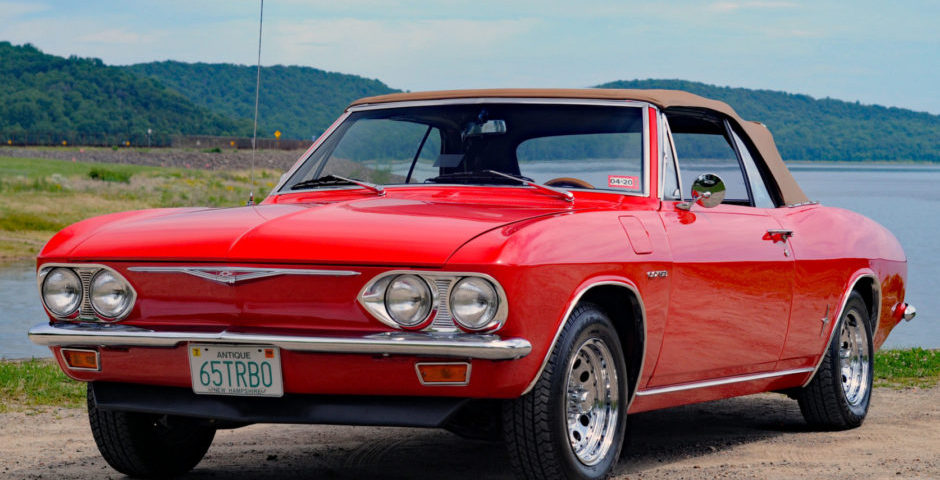
The History of the Corvair
The Chevrolet Corvair was one of the most unconventional and controversial American cars of the 20th century. Produced by Chevrolet from 1960 to 1969, it stood apart from other U.S. cars because of its rear-mounted, air-cooled engine—an approach more commonly associated with European brands like Volkswagen and Porsche.
Here’s a clear look at its history:
Origins (Late 1950s)
In the late 1950s, American automakers were responding to growing interest in compact cars. Imported cars—especially the Volkswagen Beetle—were gaining popularity in the U.S.
Under the leadership of Ed Cole (then a key executive at General Motors), Chevrolet developed the Corvair to compete in this emerging compact segment. Unlike its domestic rivals (the Ford Falcon and Plymouth Valiant), the Corvair was engineered with:
-
A rear-mounted, air-cooled flat-six engine
-
Independent suspension on all four wheels
-
A lightweight unibody design
This made it one of the most advanced American cars of its time.
First Generation (1960–1964)
The Corvair debuted in 1960 as a compact sedan. It later expanded into multiple body styles:
-
2-door coupe
-
4-door sedan
-
Convertible
-
Station wagon (Lakewood)
-
Van (Greenbrier)
-
Pickup (Rampside and Loadside)
-
Monza sport coupe
Early Popularity
The sporty Monza trim became particularly successful and helped inspire the “pony car” movement that would later lead to the Ford Mustang.
Handling Controversy
The first-generation Corvair used a swing-axle rear suspension design. Under certain conditions—particularly when tire pressures weren’t maintained correctly—the car could experience oversteer.
Although many modern historians argue the issue was exaggerated relative to other cars of the era, it would later define the Corvair’s legacy.
Ralph Nader & “Unsafe at Any Speed” (1965)
In 1965, consumer advocate Ralph Nader published the book Unsafe at Any Speed.
The first chapter sharply criticized the Corvair’s early suspension design, claiming it was dangerously unstable. The book sparked national debate about auto safety and led to:
-
Congressional hearings
-
Major changes in automotive safety regulations
-
The rise of the modern consumer safety movement
Chevrolet later made suspension improvements (and had already introduced major redesigns by 1965), but the damage to the Corvair’s reputation was significant.
Interestingly, a 1972 National Highway Traffic Safety Administration study later concluded the 1960–63 Corvair did not have a higher loss-of-control potential than comparable vehicles of its time.
Second Generation (1965–1969)
In 1965, Chevrolet completely redesigned the Corvair. The second generation featured:
-
Fully independent rear suspension (similar to the Chevrolet Corvette)
-
Improved handling
-
Sleeker, European-inspired styling
Many enthusiasts consider the 1965–1966 Corvair one of the best-handling American cars of its era.
However, by this point:
-
Sales had dropped
-
Public perception had shifted
-
Internal support within GM weakened
End of Production (1969)
Production steadily declined through the late 1960s. The last Corvair rolled off the assembly line in 1969. In total, about 1.8 million Corvairs were produced.
Legacy
Today, the Corvair is remembered as:
-
One of the most innovative American cars of its time
-
A case study in automotive safety history
-
The car that helped launch the consumer protection movement
It remains popular among collectors and has a strong enthusiast community.